Six voices from a distinctly American tradition.
Fa So La! brings together six anthems, hymns, and fuging tunes from the American Shape Note tradition: Soar Away, Sweet Prospect, Pacific & Daniels, Idumea, and Northfield. Steven Light’s concert-band setting draws on their open harmonies, direct melodic lines, and the vigorous communal sound of Sacred Harp singing.
 View score & parts →
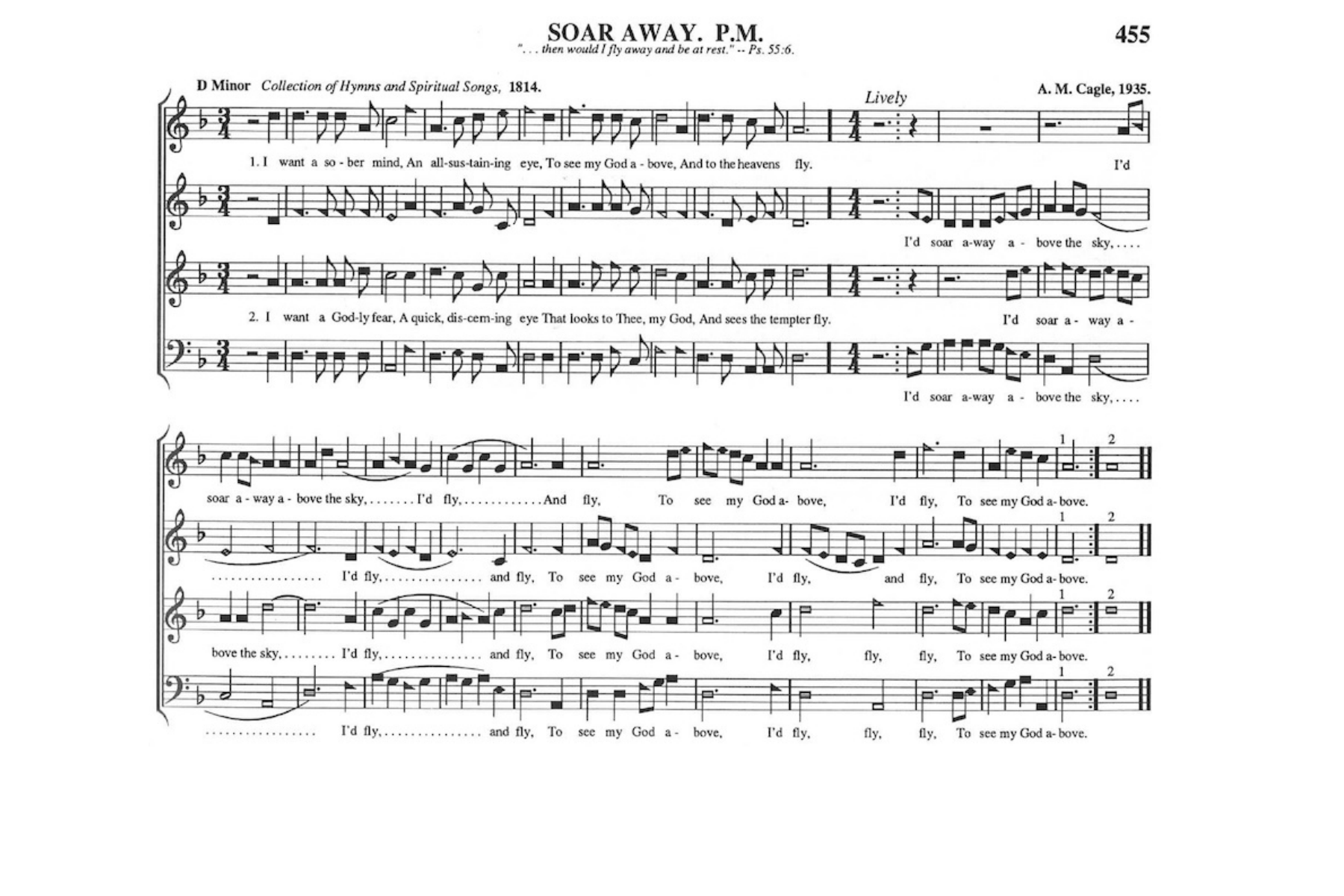
The first page of Soar Away from the 1991 Denson edition of The Sacred Harp.
Watch the score unfold.
This video pairs the audio with a scrolling score.
Program notes for the six tunes.
Soar Away
Soar Away is typically sung in a strong, forceful, full-voice style. The accents and dynamics in this instrumentation emulate that style. The piece changes tempo and meter between its two sections. It is a favorite at singing conventions, where many singers gather in a large square, one voice part on each side, with the leader standing in the middle.
Sweet Prospect
In a lilting triple meter, Sweet Prospect is one of the sweetest tunes in The Sacred Harp. This arrangement for woodwinds—flutes, oboe, clarinets, bass clarinet, and bassoon—explores the composition’s harmonies by presenting the soprano and tenor lines, then the alto, tenor, and bass lines, before the complete four-part piece.
Pacific & Daniels
Pacific and Daniels are more contemporary compositions in the Shape Note style. Glen Wright composed Pacific and sang in Norumbega Harmony, a group devoted to Shape Note music. Neely Bruce composed Daniels and was chair of the first New England Sacred Harp Convention. Both are “fuging” tunes, in which the second section is written in a contrapuntal, fugal style. They are arranged here for saxophone quartet without a break between them.
Idumea
Idumea, pronounced Id-u-MAY-a in the north and sometimes I-DU-me-a in the south, is another hymn that is mostly homophonic and very powerful. This brass arrangement explores its quiet, rich harmonies by adding one part at a time: melody in the tenor line, then bass, alto, and soprano.
Northfield
Jeremiah Ingalls was born in Massachusetts but lived in Vermont throughout his adult life. He was the first choir director of the Newbury, Vermont, Congregational Church. Northfield represents the Shape Note tradition before it left New England and traveled south: a quintessential fuging tune—simple, exciting, and joyful. The arrangement begins as a fantasy, moves into a vocal rendition using the original four shapes, and ends with a full-band treatment that evokes the music’s inherent joy and power.